Single-loop vs. dual-loop facility cooling systems: how loop architecture affects compressor energy, mechanical power allocation, and the power left for compute in high-density data centers.

Air-side equipment wants cold water. Fan walls and CRAHs are heat exchangers moving heat out of room air, and the colder the supply water, the less coil surface and airflow they need to hold the room. Depending on the design, that typically means chilled water somewhere in the low-20s Celsius or below.
Direct-to-chip cooling wants something else entirely. Cold plates sit directly on the processor, and the coolant distribution unit (CDU) can do its job comfortably with facility water well into the high-30s and low-40s Celsius. At those temperatures, a dry cooler or cooling tower can carry most or all of the load for much of the year in many climates without a compressor running at all.
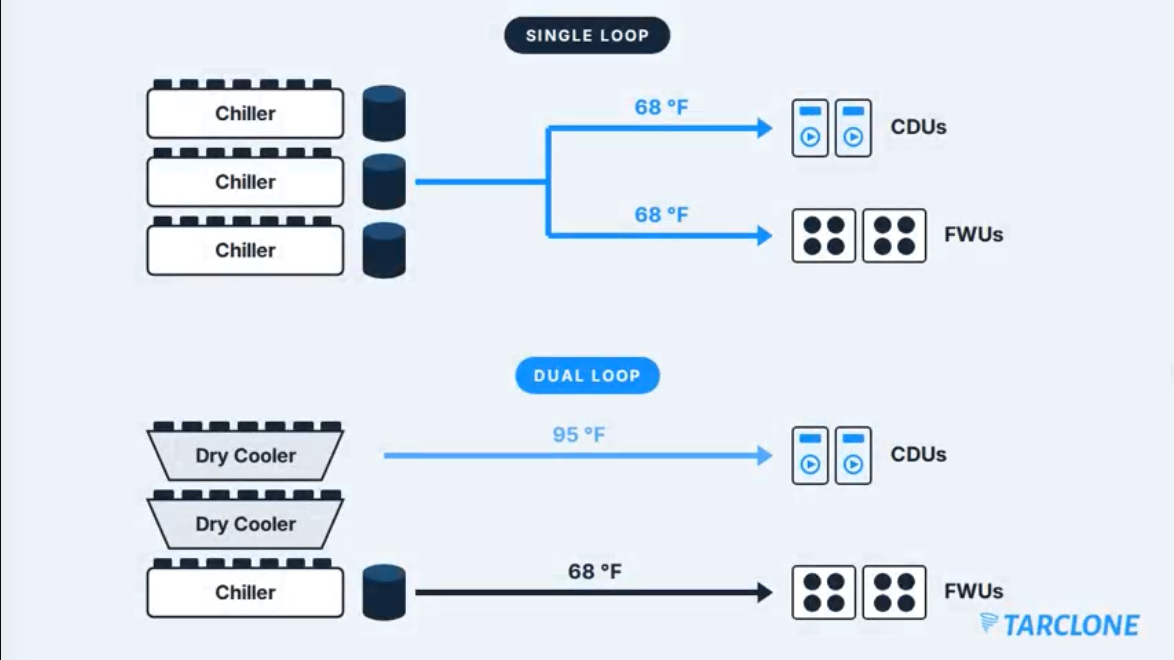
A single-loop FCS has to satisfy both. In practice, that means the loop runs at the temperature the air side needs, and the liquid side simply takes water that is colder than it requires. The compromise is invisible on a piping diagram. It shows up in the chiller schedule, in the mechanical electrical allocation, and in the utility bill.
A dual-loop FCS separates the two services. A low-temperature loop serves the air-side equipment and runs on conventional chilled water. A high-temperature loop serves the CDUs and runs as warm as the IT equipment will allow. Each loop is sized, staged, and operated on its own terms.
The practical effect is that the high-temperature loop needs far less compressor capacity. For a large share of its operating hours it may need none, relying on dry coolers or towers in free-cooling mode and calling on mechanical cooling only during the warmest periods. Chiller count comes down. The electrical gear feeding the mechanical plant comes down with it.
That mechanical power does not disappear. In a site with a fixed utility feed, every kilowatt the cooling plant no longer needs is a kilowatt that can be allocated to compute. At today's rack densities, that reallocation is not a rounding error. It is capacity the operator can lease.
We want to be direct about the other side of the argument. A single-loop design carries lower first cost. There is less pipe, fewer pumps, one set of controls, and a simpler commissioning sequence. For a site with a low liquid-cooling ratio, or one that expects to stay there, holding one cold loop for everything is the sensible choice. The extra compressor energy spent overcooling a small liquid load is small, and the simplicity is worth more than the savings.
Dual-loop also adds scope. Two loops mean more piping, more valves, two sets of pumps and controls, and a more involved staging strategy. Anyone who tells you it is free is not being straight with you. The case for dual-loop is not that it is simpler. It is that, above a certain liquid ratio, the operating and capacity penalty of a single cold loop becomes larger than the added scope.
The honest answer to "which is better" is "it depends on where your liquid ratio is going." Every site has a crossover point where dual-loop begins to pay for itself, and it moves with climate, rack density roadmap, utility constraints, and how the site is phased.
A few questions tend to surface it quickly. What share of the IT load will be liquid-cooled at day one, and what share in five years? Is the utility feed the binding constraint on the site, or is it land or capital? What does the local climate offer in free-cooling hours at a warm-loop temperature versus a cold-loop temperature? Is the site being built in phases where the loop architecture can be set now and the equipment added later?
When the liquid ratio is heading toward the majority of the load, and the utility feed is the constraint, we find the crossover point is usually closer than the first-cost comparison suggests. When the liquid ratio is modest and stable, single-loop is often the right call, and we would rather say so than sell a design a site does not need.
Tarclone works across the complete chilled water plant: chillers, dry coolers, coolant distribution units, and thermal energy storage. That matters for this question because the loop architecture decision is not one piece of equipment. It is how the pieces are sized and staged together. A dual-loop design done well is a plant-level design, and it is easiest to get right when one team is looking at the whole system rather than one line item at a time.
Our view is that as liquid ratios continue to climb, dual-loop becomes the default for new high-density builds, and single-loop becomes the specific choice for sites with a clear reason to stay there. Either way, the decision deserves to be made on purpose, with the power budget on the table, rather than inherited from a design standard written for a different generation of load.
First cost buys the plant. Loop architecture decides what it earns.


Cooling, power, and control you can count on.
© 2026 Tarclone Infrastructure Solutions. All rights reserved.