Why data centers at 50 MW and below are underserved on cooling infrastructure, what that costs operators in lead time and design fit, and how a complete chilled water plant approach changes the equation.

Talk to the people building and operating these sites and a consistent set of frustrations comes up.
Lead times are the first. When a manufacturer's capacity is committed to a small number of very large customers, a 20 MW order goes to the back of the queue. Chillers and dry coolers that once shipped in a predictable window now carry lead times that can push a project's schedule by quarters. Coolant distribution units, which are new enough that many operators are ordering them for the first time, are often worse.
Design fit is the second. Product lines tuned for hyperscale tend to arrive in capacity blocks and configurations that suit a 300 MW campus and not a 15 MW building. The mid-size operator ends up either overbuying capacity to fill the smallest available module or assembling a plant from pieces that were never designed to work together.
Attention is the third, and in some ways the most costly. Application engineering, factory support, and commissioning resources follow the largest orders. A regional colocation operator adding a liquid-cooled hall for the first time needs more help, not less, and often gets less.
It would be easy to read all of this as a story about a segment stuck with the short end. We see it differently. A 20 or 30 MW site can do things a gigawatt campus cannot, and the current moment in cooling design rewards those things.
It can move faster. A single building with a clear owner can make a design decision in a meeting rather than a quarter, which matters when the technology itself is changing as quickly as liquid cooling is.
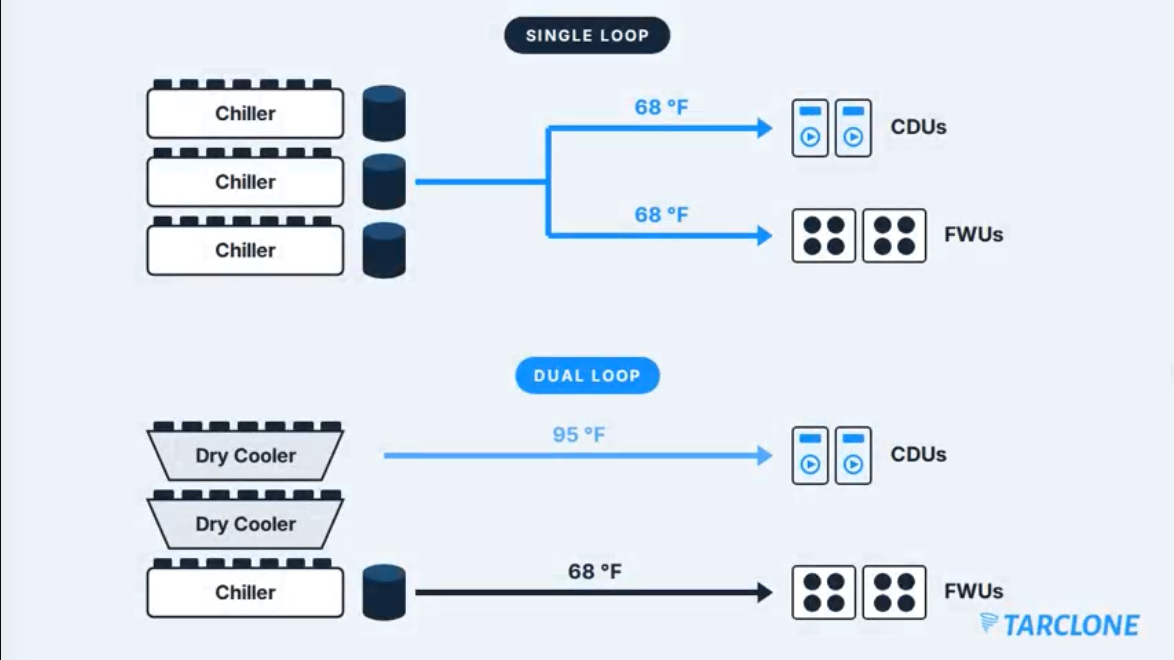
It can adopt the right architecture from the start. Many mid-size operators are building their first high-density hall now, which means they can design a dual-loop chilled water plant around warm-water liquid cooling rather than retrofitting one into a facility built for air. The efficiency and capacity benefits of that architecture, which we have written about separately, are fully available to a 15 MW building.
And it can use modular and prefabricated equipment to full effect. Packaged chiller plants, modular CDU skids, and containerized cooling units are a natural fit for sites that need to add capacity in tranches of a few megawatts at a time. The economics of prefabrication favor exactly the scale this segment builds at.
The reason the mid-size segment is underserved is not a lack of good equipment. It is that the equipment arrives as a set of disconnected line items, each from a supplier whose attention is elsewhere, with the integration left to the operator or their engineer. The chiller is one conversation. The dry coolers are another. The CDUs, the thermal energy storage, the modular plant, each is its own procurement with its own lead time and its own application engineer.
Tarclone was built around a different approach. We work across the complete chilled water plant as a single scope: chillers, dry coolers, coolant distribution units, thermal energy storage, and modular and packaged units. For an operator building at 50 MW and below, that means one team looking at how the plant fits together, sized for the load the site actually has, with equipment selected for the segment rather than adapted down from a hyperscale product line.
It also means treating lead time as a design constraint rather than a surprise. When the schedule is known at the start, the plant can be selected around it.
Tarclone's focus is the 0 to 100 MW colocation and wholesale market, with the most attention at 50 MW and below, and the choice was deliberate. It is the part of the industry where the gap between what operators need and what they are being offered is widest. It is the part where a complete plant approach makes the largest difference to schedule and to design quality. And it is the part where the people making decisions are close enough to the project to value a partner who shows up.
The hyperscale segment will continue to draw the headlines. That is fine. The 50 MW data center is where most of the industry lives, and it deserves a cooling plant designed for it.


Cooling, power, and control you can count on.
© 2026 Tarclone Infrastructure Solutions. All rights reserved.