How data center cooling choices affect surrounding communities through water use, noise, grid load, and heat rejection, and what operators and developers can do about it before permitting.

Water is the concern that comes up first in nearly every community meeting, and for good reason. Evaporative cooling towers reject heat by consuming water, and at scale that consumption competes with municipal, agricultural, and residential demand. In water-stressed regions, it can be the single issue that stalls a project.
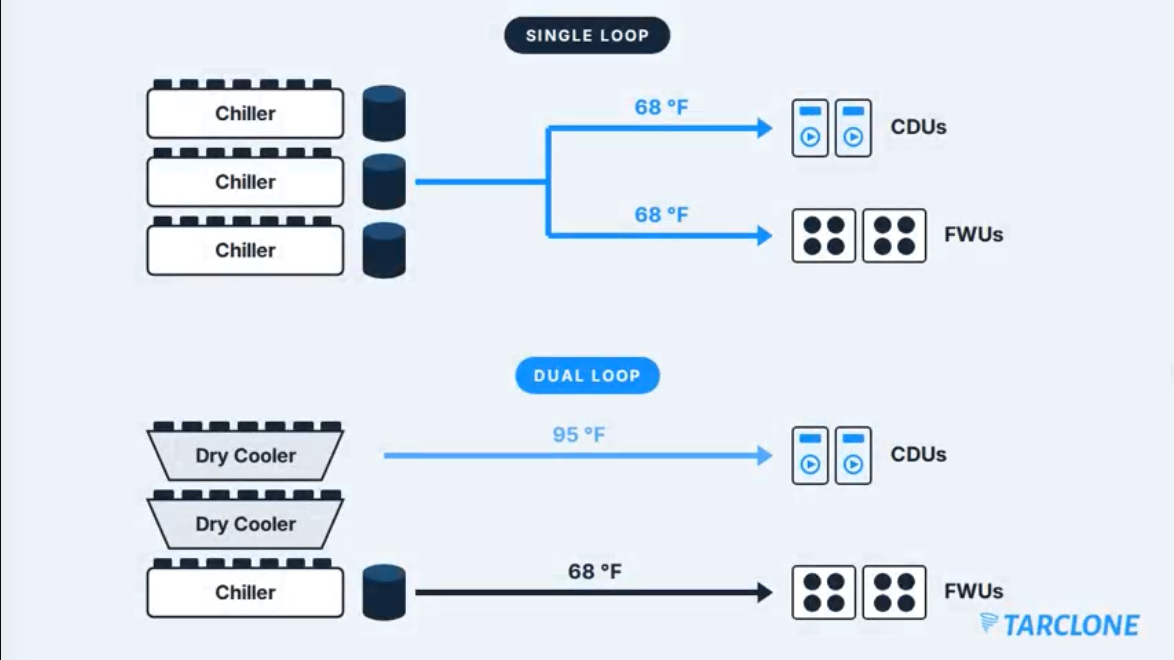
The design levers here are well understood. Closed-loop chillers and dry fluid coolers reject heat to the air without evaporating water. Hybrid coolers run dry for most of the year and use water only during peak conditions. Higher-temperature cooling loops, made possible by direct-to-chip liquid cooling, expand the number of hours a dry cooler can carry the full load without a compressor and without water. None of these are exotic. They are choices, and each one can be made at the design stage with a clear view of what it does to the site's water footprint.
Noise is the concern most likely to persist after the ribbon is cut. Air-cooled chillers, dry fluid coolers, and generators all rely on fans, and a large mechanical yard running at full speed on a summer night is audible well beyond the fence line. Residents who supported a project during permitting can become its most vocal critics once they can hear it from their residence.
The mitigation is partly equipment and partly layout. Low-speed, larger-diameter fans move the same air more quietly. Variable-speed drives allow the plant to run slower during the hours when demand and ambient temperature are lower, which are often the hours when noise matters most. Placing heat rejection equipment away from property lines, using acoustic screening, and modeling sound propagation at the site plan stage cost far less than retrofitting after a complaint.
Communities are increasingly aware that a data center's utility connection is shared infrastructure. Every megawatt the site draws is capacity the local grid has to deliver, and the mechanical plant can account for a substantial share of that draw. A cooling design that leans on compressors around the clock takes more from the grid than one that uses free cooling for most of the year.
This is where efficiency and community interest line up neatly. Warm-water liquid cooling, well-designed free-cooling economization, and thermal energy storage that shifts chiller operation away from peak grid hours all reduce the site's demand on shared infrastructure. Thermal storage in particular is worth a closer look: it allows the plant to make cooling when power is plentiful and use it when the grid is tight, which is an easy story to tell a utility and a planning board.
Heat rejection is the least discussed community impact and the one with the most potential to turn from a liability into an asset. Every kilowatt of IT load becomes a kilowatt of heat that has to go somewhere. Today, in most facilities, it goes into the atmosphere.
Warm-water cooling changes the math on reuse. Water returning from a direct-to-chip loop is warm enough to be useful for district heating, greenhouses, aquaculture, and industrial processes in a way that low-grade heat from an air-cooled hall is not. Heat reuse is still uncommon in North America, and it requires a willing partner nearby, but a site designed with a high-temperature loop keeps that option open. A site designed without one has largely closed it.
The pattern across all four of these concerns is the same. The choices that reduce a data center's community footprint are made in the cooling design, and they are made early. Loop temperatures, heat rejection method, fan selection, equipment placement, and thermal storage are all fixed before a permit application is complete. Trying to address them afterward means change orders at best and redesign at worst.
Our suggestion to developers and operators is to treat the community impact assessment as an input to the mechanical design, not a summary of it. Bring the water, noise, power, and heat questions into the first design review. Ask the equipment suppliers to show, with numbers, how each option changes the site's footprint. Then take that analysis to the community with the design already reflecting it.
Tarclone's positioning is responsible cooling for mission critical facilities, and we mean that in the specific sense described here. The complete chilled water plant we work across, from chillers and dry fluid coolers to coolant distribution units and thermal energy storage, is where the community footprint of a data center is decided. We think operators who make those decisions deliberately will find their projects easier to approve, easier to operate, and easier to defend when the neighbors ask hard questions.
They are going to ask. The best answer is a design that already accounts for them.


Cooling, power, and control you can count on.
© 2026 Tarclone Infrastructure Solutions. All rights reserved.